Why it matters
Think back to the last morning your gut felt irritated. Was it a Tuesday or a Wednesday? If you have to stop and think, you already know the problem.
A food record shows what went in. Your gut gives its answer later in the bathroom, where nobody takes notes and memory has to do all the work. You may stop noticing a change that comes on slowly, because you live with it every day. An entry you make today will still say exactly what happened when you look back in a month.
What the screen asks
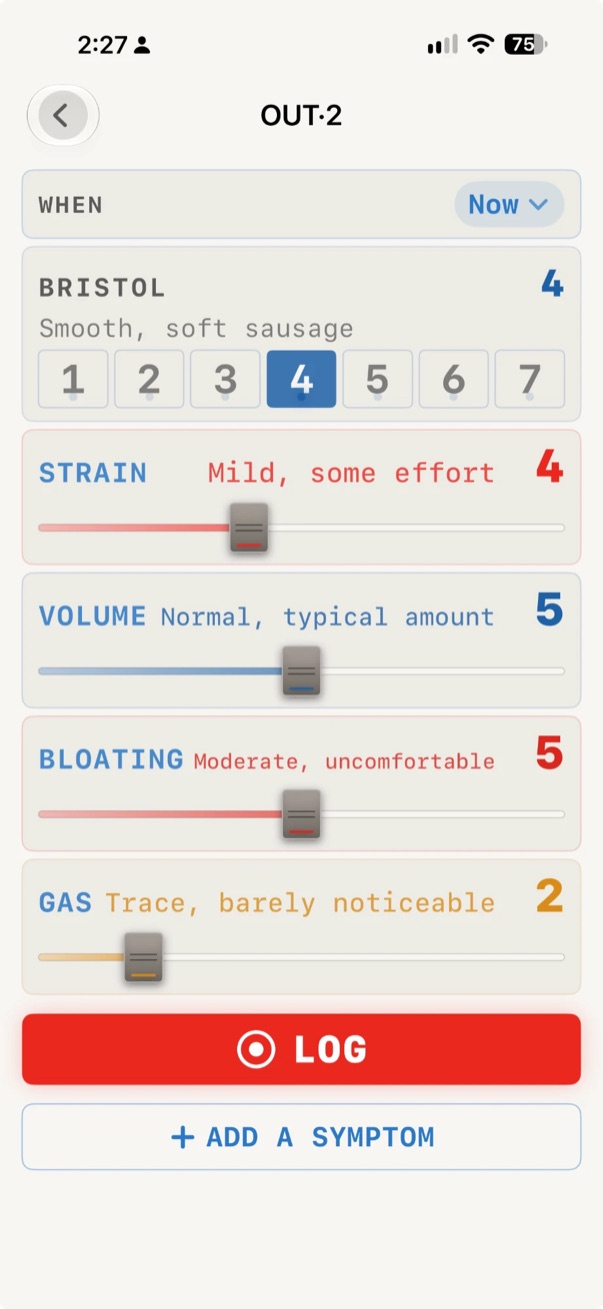
The screen opens on the Bristol stool scale, a chart clinicians use to sort stool into seven types by shape. Type 1 is hard separate lumps and type 7 is entirely liquid. Say you tap 4 because the app's label fits: smooth, soft sausage. That number will mean nearly the same thing next month, which a word like "normal" cannot promise.
Below the scale sit four sliders that run from 0 to 10 and put each level into words, so you never have to guess what a 6 means. When something else matters to you, ADD A SYMPTOM puts your own row on this screen as a 0 to 10 scale or a plain yes or no.
You had to push a little, so Strain goes to 4. Strain sits next to the scale so the record shows both what the stool looked like and how hard it was to pass.
Volume records how much came out. Today it sits at 5, a normal amount.
Your belly feels tight, so you drag Bloating to 5. You have barely passed any wind, so you set Gas to 2.
Bloating is the feeling of fullness and Gas is the wind itself. They get separate sliders because a day like this one brings one without the other. Logged beside your meals, the two show whether either keeps coming back after the same foods. Both have other causes, so one day proves nothing.
Any slider you skip stays blank, because GI Studio will not fill in a zero for you. A zero is a claim that you had none. If skipped sliders counted as zero, your bloating would seem to improve in exactly the weeks you were too busy to answer.
What a month shows
Say that by the end of the month you have logged nine type 6 mornings. When you read them beside your meals, six followed a late dinner out. That does not prove the dinners did it, because sleep and stress can move these numbers too. It does hand you a question worth testing, which memory alone would not have.
Keeping it quick
GI Studio keeps logging short because the urge rarely waits. A pee is one tap on the home screen. A bowel movement opens this one screen, where LOG saves the entry whether you filled in everything or nothing.
Even a bare entry records that you went and when. If you could not log in the moment, the WHEN control sets an earlier hour from today or yesterday. Next time you go, the entry takes two taps.
See a doctor when something about your gut worries you or changes in a way that is not normal for you. GI Studio keeps a record of what happened and never stands in for that visit.